
Pattern Matching the Impossible
Good companies come from opportunists. Generational ones come from the obsessed.

As a venture nerd, one of my favorite conference activities is walking into a founder mixer and challenging myself to spot a “killer” just by reading the room. It’s a three-step process: 1. identify the potential killer, 2. drift into their proximity and listen to their conversations, and 3. initiate a conversation for validation.
VCs pattern match for a living, but the diversity of what makes someone a killer founder truly defies all existing stereotypes and frameworks — especially when there isn’t much data to go off: young, first-time founders, outside the network, with no blue-chip pedigree or track record in a new sector. No, MBTI won’t help here — that’s a personality tool, useful for assessing a friend, coworker, or life partner.
I don’t care about compatibility. My questions are more binary: is this founder a killer or not? And how “raw” vs. “polished” is this gem?
Reading the “On-paper”
Founder Success = Obsession + Ambition + Aptitude
Obsession (the #1 quality I look for)
As I collect more data points on founders since the start of my career in venture, founder obsession has become the landslide leading indicator of how far they can take a project. Obsession can't be faked: it’s the unique insight no one else saw; the stamina to climb an uphill battle with no one cheerleading; and the grit to keep building when momentum-chasing VCs call you 'too early.'
Here’s a non-negotiable question I ask myself before making any investment decision: if no one gives this founder another cent, are they obsessed enough to keep building anyway?
Good companies come from opportunists; generational ones come from the obsessed.
Ambition:
Signals for ambition are relatively easy to spot. A classic one is "chip on the shoulder puts chips in the pocket." Another is a record of being somewhat "unemployable / relentlessly entrepreneurial," never quite fitting inside others' systems. A third — and a rather unusual question I ask some founders — is how they would rank money, power, and prestige in importance to them. There's no right answer, but it's always telling.
Aptitude:
Signals for aptitude can show up in many forms. One is “unfair advantage,” even if manufactured. Not every startup can be king-made like Snowflake — incubated by VCs and inheriting the Rolodex — but founders can manufacture their own edge by becoming the expert in their respective field through deep research and obsession (hence the importance discussed above).
Another signal is evidence of "punching above their weight." It's not about the cards someone is dealt, but how they play them. Not every killer is Ivy or ex-FAANG blessed. Sure, getting into a top school likely means someone did well in high school (excluding legacy kids), but that says little about adult life. Many strong founders just weren't lucky enough to be picked up by Ivy admissions, couldn't afford the tuition, or were late bloomers who coasted through high school, went to non-target colleges, and then had to work doubly hard to break into Wall Street. Landing a first job at Goldman from a non-target school is a very green flag to me.
A third signal is evidence of a "hard pivot." Pivoting from accounting to IB is a moonshot. Even within consulting, firms love to pigeonhole people into a service line or industry because retraining is expensive. Breaking out of that mold takes courage, grit, ambition, and curiosity — all of which translate directly to founder quality.
Reading the “Off-Paper”
Reading what’s “off paper” is the real craft. What if founders weren’t “trying” at the moment you met them? How do you tell someone is impressive when you meet them in non-work mode — when they aren’t putting on a show because they only care about getting a16z on the cap table? When they’re quiet “sigmas” sitting in a corner with zero urge to tell you what they know? When they’re introverts, or intentionally keeping things on the DL?
A few tells I’ve come to notice when observing founders in an open social setting:
Killer founders are not earnest to please: they aren't approval-seekers in conversation, nor are they typically the smoothest talkers. They aren’t eager contributors to every conversation, but when they do speak, it’s substantive and thoughtful.
Killer founders don’t pitch — they tell: here’s the reality you don’t see, and I’m showing it to you. The tone is never salesy, but measured and firm. The best founders take you on a reality distortion into the future. Some of my best investments happened after conversations that felt like a nutritious meal for my mind.
Killers have a certain intensity and stillness: there’s a low hum of energy that doesn’t need an outlet. They aren’t fidgety, they aren’t performing. It’s the stillness of someone with a quiet self-knowing that they’re among the most interesting people in the room, whether or not anyone else has figured that out yet.
But here’s the catch: that stillness is easy to overlook — especially when someone louder, smoother, and more eager to charm you is standing right next to them.
That’s most confounding variable of all — the trap of charisma.
The Trap of Founder Charisma
An articulate and charismatic founder like Sam Altman or Jensen Huang is every VC’s dream. To the left of the founder charm spectrum you have Elon Musk and Alex Karp; too far right and you’re veering into Adam Neumann and Elizabeth Holmes territory.
Interestingly, the “curve of diminishing returns on founder charm” follows the same trajectory as the Yerkes-Dodson curve — which states that performance increases with stimulation, but only up to a point. After that peak, more charisma, like more stimulation or stress, drives outcomes off a cliff.
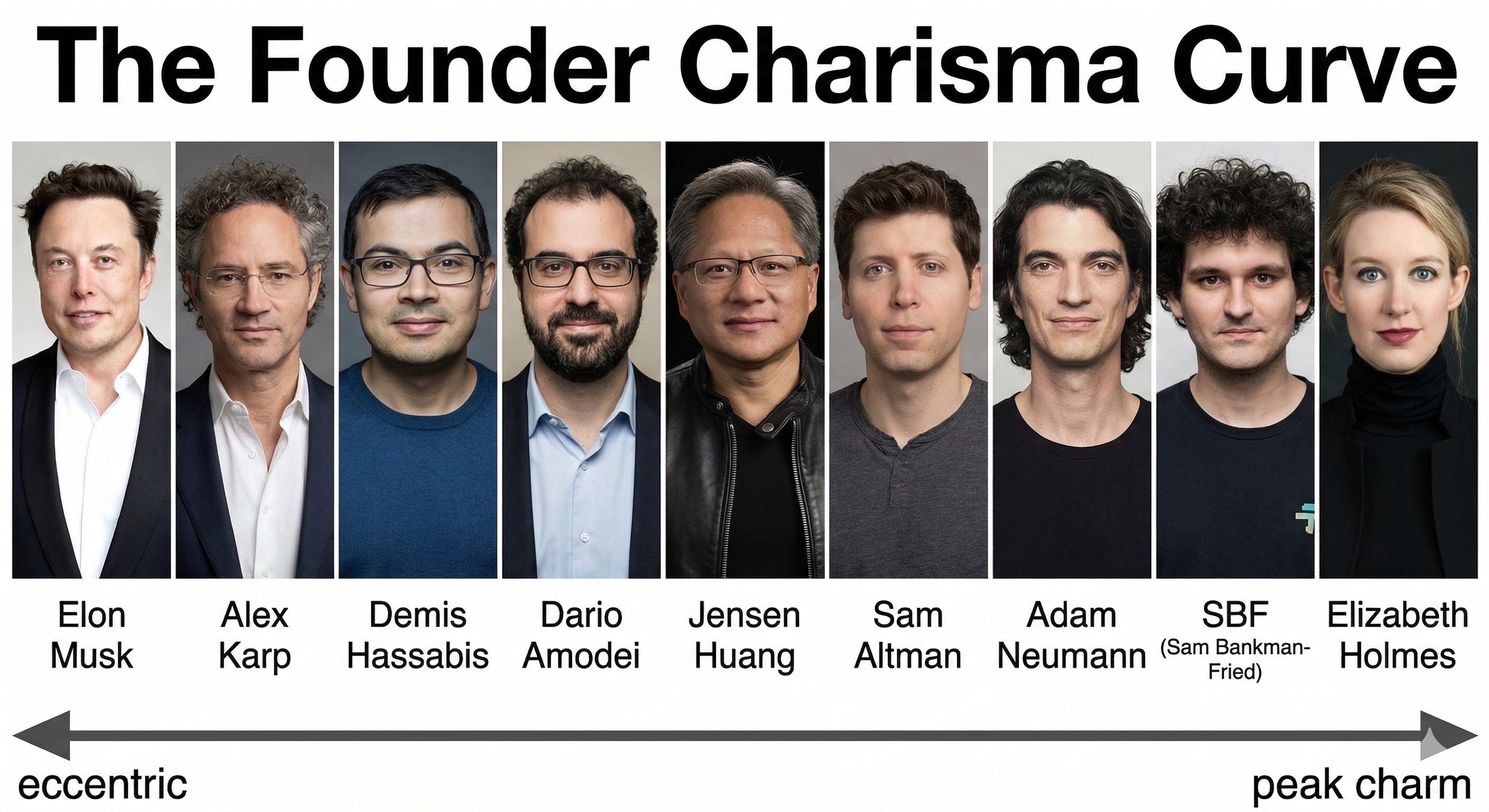
This is where most false positives and false negatives happen.
False positive: founders with dazzling charm and eloquence that masks thin aptitude and a shakier execution track record.
False negative: introverted, unassuming, sometimes “awkward” founders who struggle to compress their thinking into a 30–60 minute pitch — not because they’re poor communicators (which is definitely a dealbreaker), but because they’re deep in a complex, multi-layered mind palace and need help zooming out to the big picture.
In fact, this is consistently the most sought-after help our portfolio founders ask us for. They often have the right materials — they just need a trusted thought partner and sounding board to help package them into a digestible format for fundraise or user audience.
Being a great VC — especially at the earliest stage — is not easy: constrained data points, extreme variance across founder backgrounds and sectors, multi-year delayed gratification, and the ever-present possibility that the founder you backed pivots in a completely different direction tomorrow.
It is a world of 10% constant, 90% variable. But here’s the secret: that 90% is entirely anchored in people, and human nature hasn’t changed for millennia. Master that, and the rest is just pattern recognition.